
What is the 3-30-300 Rule and why does it matter?
If you’re based in a conurbation, how many trees can you see from where you’re sitting right now?
Not in the distance or beyond the skyline, but from your desk, kitchen table or home office window. It’s a surprisingly simple question and one that often reveals how disconnected daily life in towns and cities can be from nature.
That question also sits at the heart of the 3-30-300 Rule, a clear, human focused framework that is gaining increasing attention across the urban greening, planning and landscape sectors. And yet, despite its growing relevance, many people working in the amenity and horticultural industries are still unfamiliar with what the rule really means in practice.
We believe that needs to change and are launching a series of blogs to help do this.
What is the 3-30-300 Rule?
First proposed in 2021 by urban forestry expert Cecil Konijnendijk, the 3‑30‑300 Rule is a straightforward way of thinking about how people experience trees and green space in their everyday lives.
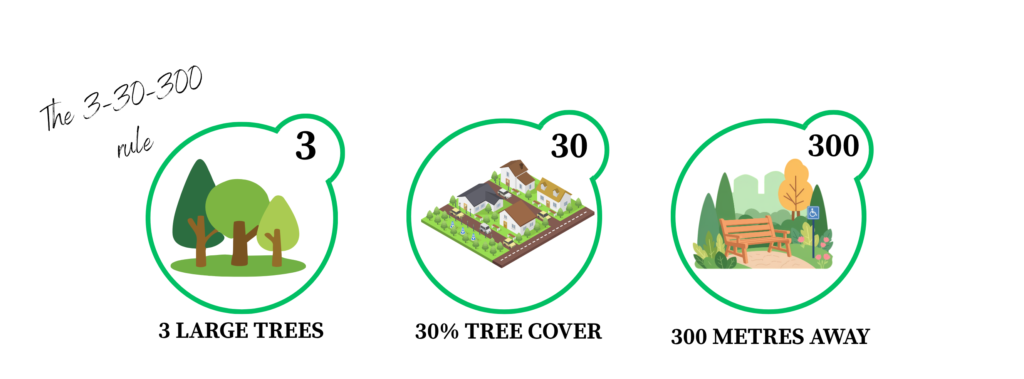
The rule sets out three simple principles:
- • Three trees visible from every building
- • 30% tree canopy cover in every neighbourhood
- • Green space within 300 metres of every home
Unlike long term environmental targets that can feel distant or abstract, the 3-30-300 Rule focuses on what residents can see, reach and benefit from every single day. It places human experience at the centre of urban design and reminds us that access to trees is not a luxury – it’s important for health and resilience.
Why does it matter now?
Towns and cities are under increasing pressure from climate change, rising temperatures, densification and growing demands on public space. At the same time, awareness of the links between nature, wellbeing and quality of life has never been greater.
Trees play a critical role in addressing many of these challenges. They provide shade, reduce urban heat, capture carbon, improve air quality and create habitat, while also delivering less tangible benefits such as stress reduction and improved mental health.
Yet too often, trees are still being seen as a ‘nice to have’ – something added late in the design process, value engineered out, or planted without long term canopy outcomes in mind. The3-30-300 Rule challenges that thinking by reframing trees as essential urban infrastructure, not optional extras.
From theory to everyday life
What makes the 3‑30‑300 Rule so powerful is its simplicity.
Three visible trees isn’t an abstract metric, it’s immediate and personal. Most people can tell you instantly whether they meet that threshold or not. Similarly, the idea of having green space within 300 metres is easy to visualise and directly linked to how often people actually use it.
This focus on lived experience is what sets the rule apart. It doesn’t just ask how many trees are planted somewhere in a city, but how they shape daily life on streets, in neighbourhoods, around homes and workplaces. Visibility, proximity and canopy cover all contribute to whether green infrastructure genuinely works for people.
Why we’re championing the rule
Despite its relevance, the 3-30-300 Rule remains one of the industry’s best kept secrets.
Kersten, our Sales and Marketing Director, explains:
“What’s striking is how many people in the amenity and horticultural sectors are still unfamiliar with the 3 30 300 Rule. Some have never heard of it, others know the phrase but not what it really means in practice. That’s why we feel it needs to be in the spotlight, talked about and used.”
As a long established supplier of trees, hedging and plants to housing developments, public landscapes and infrastructure projects, we see first hand how planting decisions influence canopy cover, resilience and long term success. We’re already seeing growing interest in climate resilient trees and biodiversity led planting, but awareness alone isn’t enough.
The more the 3-30-300 Rule is discussed, adopted and embedded early in design conversations, the quicker it moves from a helpful concept to something that genuinely shapes better places.
Turning awareness into action
During the next 12 months, we’ll be sharing a series of free advice and insight blogs exploring the 3-30-300 Rule in more detail, from canopy cover and species selection, to planning decisions and long term resilience.
Our aim is simple: to help planners, landscape architects, developers and local authorities turn principles into practice and to ensure trees are specified in ways that deliver real, measurable benefits for people and the environment.
Because every tree makes a difference and every well planned green space helps create healthier, more resilient towns and cities.
So now, take a moment. Look out of your window.
Can you see three trees?
If you’d like to join the conversation, please share a photo of what you can see and tag us on social media using #ThreesRule and #TreesRule.